Space Meetings Veneto 2026 confirmed one thing clearly: the European space sector is entering a new phase. More connected, more data-driven and increasingly interdisciplinary, the sector is evolving quickly.
Over three days in Venice, more than 400 companies from 25 countries, research centres, space agencies, startups and industrial players gathered around the same questions: autonomy, sustainability, AI, infrastructure and the future of space operations.
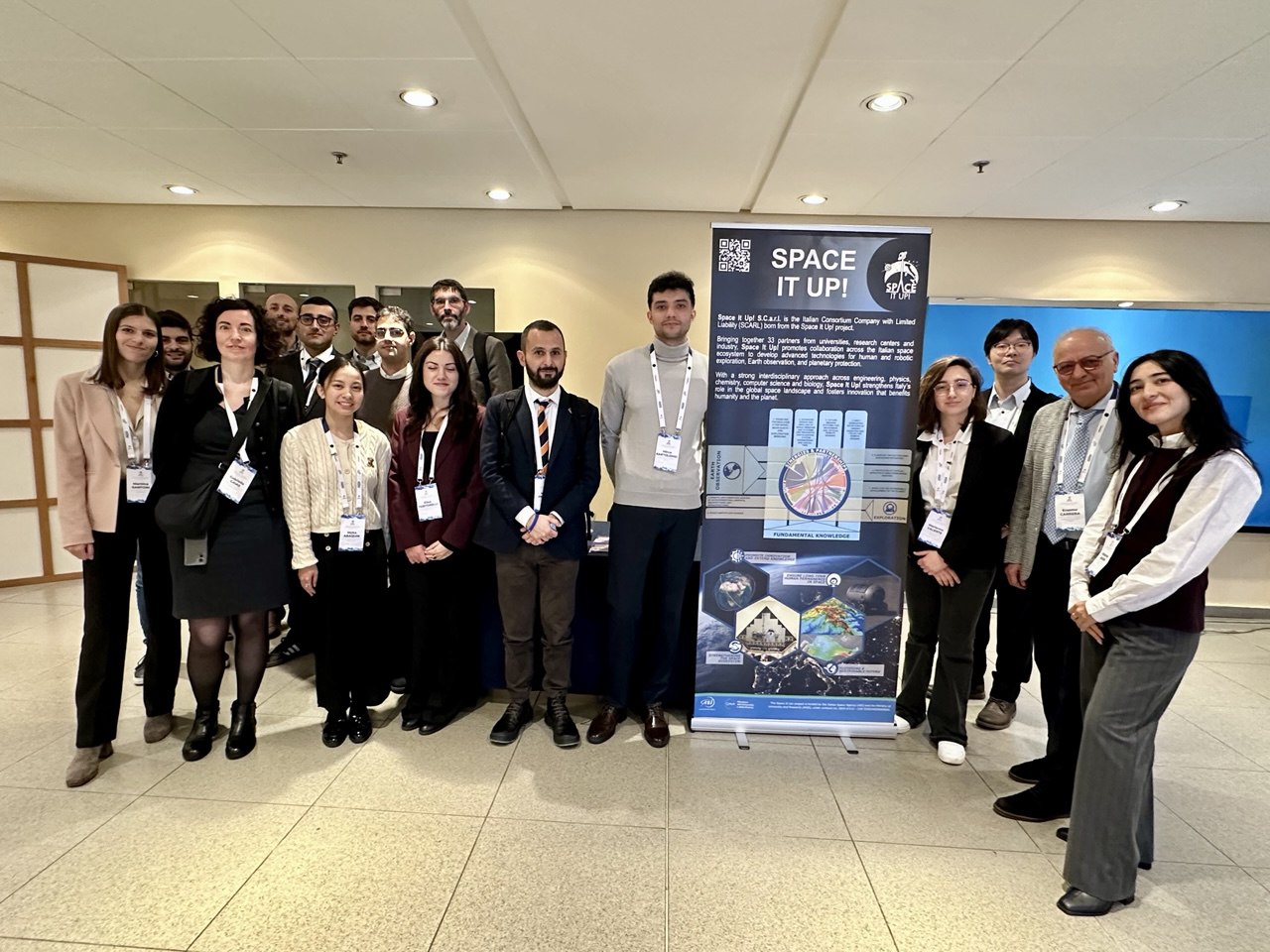
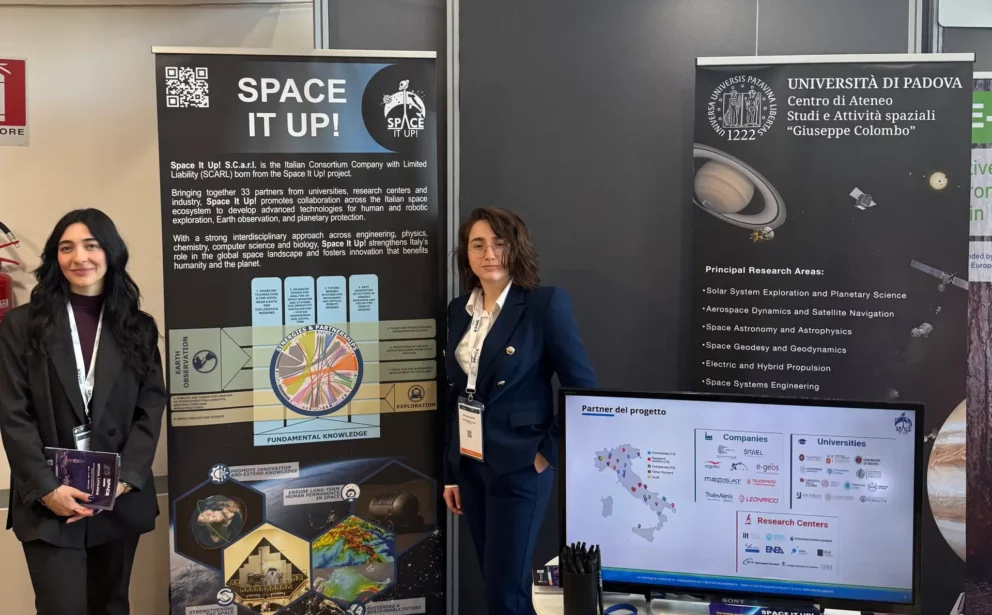
Space It Up! was there. We joined the event at the CISAS “G. Colombo”, Università di Padova booth, one of our 33 partners. As Italy’s only partnership bringing together the national space value chain, it felt like the right place for us to be.
Space It Up! and the Italian Space Ecosystem
Two years into the programme, Space It Up! came to Venice with a strong voice in the conversation. Funded by Agenzia Spaziale Italiana (ASI) and Ministero dell’Università e della Ricerca (MUR) with €80 million, the programme has now been extended to July 2028.
So far, it has produced more than 300 publications co-authored by over 1,000 researchers, while its nine thematic Spokes continue to grow their presence at national and international scientific conferences.
Venice was both an opportunity to share what the partnership has built so far and a chance to engage directly with industry and academia: to listen, compare notes and reflect on the broader signals coming from the sector.
Beyond meetings and exhibition stands, it was a rare occasion to be in the same place at the same time as the people whose work connects to ours. Researchers, companies, agency representatives and startups all contributed to the conversations that shaped these three days. Many of the most valuable exchanges happened in the corridors, over coffee or at the booth, while the panels helped define the common themes and future directions for the sector.
AI in Space: From On-Board Intelligence to Orbital Data Centres
Beyond networking, the scientific programme offered several sessions that mapped directly onto the work already being carried out across Space It Up!’s nine Spokes.
One of the most significant focused on artificial intelligence in space.
The shift is real and structural: the volume of data generated in space has grown to a scale that makes the traditional model, generate in orbit and process on the ground, increasingly difficult to sustain. On-board edge processing is becoming a necessity, not an option, for Earth observation constellations and exploration scenarios alike.
What the panel made clear, and what resonates with our own work, is that on-board intelligence does not reduce the role of the ground segment: it redefines it. Ground operations shift from data processing to logic updates, model retraining and managing scenarios not foreseen at design time.
For mission-critical and irreversible decisions such as collision avoidance, the human in the loop is expected to remain part of the architecture for the foreseeable future. This is not only a matter of caution, but also a consequence of the explainability requirements that characterise the domain.
The concept of orbital data centres was also discussed in practical terms. Many current infrastructures remain technology demonstrators rather than continuous services. At the same time, two structural drivers, abundant solar energy and the absence of water-cooling constraints, make a meaningful migration of computing capacity to orbit plausible in the medium term.
Space Technologies, Sustainability and Agriculture
Another particularly thought-provoking session explored the relationship between space, science, technology and agriculture.
One of the key insights was that space is often required to adopt sustainability as a structural operating logic before similar solutions become widespread on Earth. Closed-loop bioregenerative systems, greenhouses designed under strict weight and volume constraints, and advanced water and energy optimisation strategies are direct responses to challenges faced in space environments.
At the same time, the technologies developed for scientific and Earth observation missions are increasingly finding applications in agriculture. Multispectral and hyperspectral imaging systems are helping enable more precise and efficient agricultural practices and are entering a phase of commercial consolidation.
This intersection between space technologies and terrestrial applications is exactly the kind of area Space It Up! is already working on.
Space Situational Awareness and the Challenge of Space Debris
Space Situational Awareness (SSA) was another major topic discussed during the event.
The figures presented during the session illustrate the scale of the challenge. Global launches increased from 140 in 2021 to more than 300 in 2025, roughly one launch per day. The number of active satellites now exceeds 14,000, while tracking capabilities cover only one third of officially catalogued objects.
As the panel highlighted, the issue of space debris shares characteristics with other large-scale environmental challenges. The long-term sustainability of orbital activities depends on coordinated action and a systemic change in operator behaviour.
The session also highlighted the depth and completeness of the Italian SSA ecosystem, where academia, research centres, industry and public institutions work together across the full value chain in a rapidly expanding domain where Italy holds a strong competitive position.
What We Take Away from Space Meetings Veneto 2026
Several themes emerged consistently throughout the event. The first is the growing importance of artificial intelligence and on-board processing capabilities for future space missions. The second is the increasing connection between space technologies and sustainability challenges, particularly in areas such as resource management and agriculture. The third is the strategic importance of Space Situational Awareness as the orbital environment becomes more complex and congested.
For Space It Up!, these discussions reinforced something important: many of the questions currently shaping the future of the space sector are the same questions already being addressed across the programme’s nine Spokes.
What Venice also confirmed is something less quantifiable but equally important: the value of being present, of being part of the conversation, and of building relationships across the space ecosystem. The connections made over these three days, with research groups, companies at different stages and agency representatives, are the kind that take time to translate into concrete collaborations, but that start exactly like this.
The conversations started in Venice will not stop there. We look forward to building new collaborations across research, industry and institutions.