

 English
 Chinese

Spoke 2 topics overview
Digital Twin and Model Based procedures for space missions
This research topic focuses on developing innovative model-based system procedures for the analysis of critical elements of space systems and Digital Twins for the design, simulation, and optimization of space missions in several scenarios, from Earth Observation to Space Exploration and In Orbit Service.
A core component of this line is the development of high-fidelity integrated simulators, which allow the design, analysis, and validation of Earth satellites, planetary explorers, or space probes. The approach is complemented by Digital Twin (DT) and Hardware-In-the-Loop (HIL) systems, which combine model-based and data-driven methods to ensure robust and adaptive verification of autonomous technologies. Advanced visualization techniques based on Virtual Reality (VR) and Machine Learning (ML) algorithms are used to interpret simulation results and support decision-making.
This research line addresses the validation and verification of models through representative use cases, experimental datasets, and simulation scenarios. The model-based approach allows for simultaneous optimization of multiple design parameters, supporting informed decision-making while reducing development costs and time. The integration of artificial intelligence and machine learning tools enables the creation of predictive models that assist decision-making, allowing multiscale simulations and analysis of complex scenarios.
Research activities Details
Publications
2025
Journal publications:
- eeee
Conference publications:
- eee
2025
Journal publications:
- eeee
Conference publications:
- eee
Spoke 1 - Enabling Technologies for novel near-earth and exploration missions
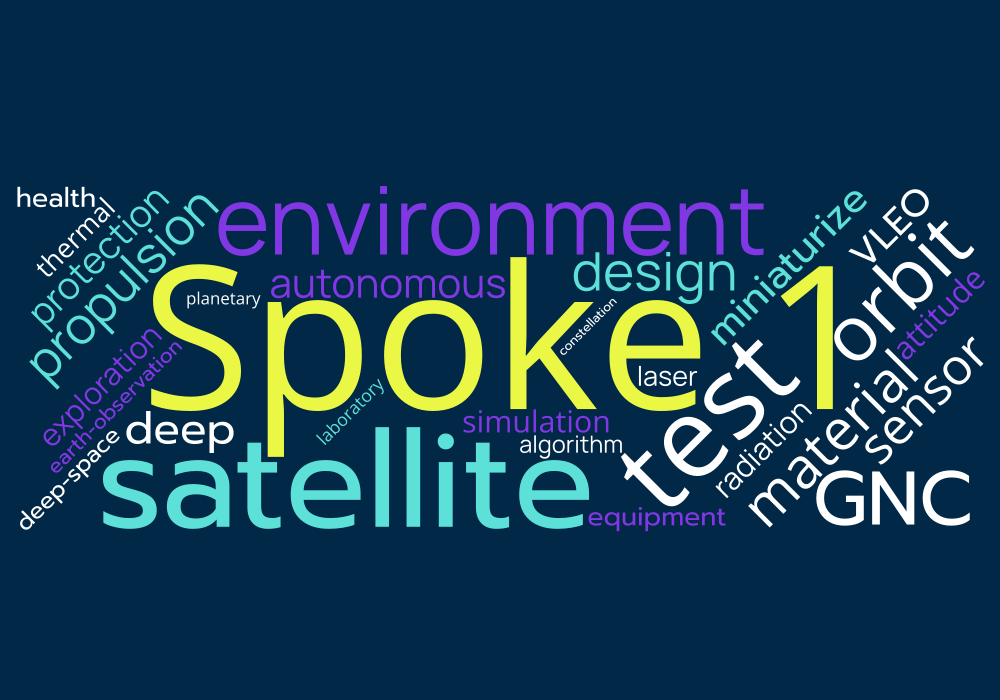
Spoke 1 encompasses a broad and integrated set of research and management activities dedicated to the advancement of next-generation space systems. Its structure is organized in four technical work packages supported by a comprehensive management layer, which ensures consistent coordination, quality, and impact across all developments.
The technical activities address three major domains. The first focuses on very-low Earth orbit platforms, where the partners investigate advanced materials for harsh environments, air-breathing propulsion concepts, multidisciplinary modelling of system–environment interactions, and optimal orbit–attitude control strategies. These efforts aim to enable sustainable operations in VLEO, improve protection from aerodynamic and radiation effects, and develop reliable propulsion and GNC solutions.
The technical activities address three major domains. The first focuses on very-low Earth orbit platforms, where the partners investigate advanced materials for harsh environments, air-breathing propulsion concepts, multidisciplinary modelling of system–environment interactions, and optimal orbit–attitude control strategies. These efforts aim to enable sustainable operations in VLEO, improve protection from aerodynamic and radiation effects, and develop reliable propulsion and GNC solutions.The second domain concerns distributed space systems, including formation flying, in-orbit servicing, autonomous coordination, and advanced onboard and on-ground data processing. Work spans from low-TRL GNC algorithms and health-monitoring concepts to enabling technologies such as inter-satellite links, high-efficiency communication, power systems, and novel propulsion concepts. The goal is to support robust coordination, enhance mission autonomy, and develop architectures for future multi-satellite systems.
The third domain focuses on deep-space exploration with miniaturised platforms, addressing autonomy in spacecraft operations, in-situ resource utilization, radiation-tolerant subsystems, and enabling technologies for small deep-space probes. Research covers new materials, advanced avionics, thermal protection, communication architectures, and innovative propulsion systems, with the aim of increasing platform resilience and mission capability in demanding deep-space environments.
These scientific and technological developments are supported by a dedicated work package on procurement, laboratory infrastructure, and external services, which provides the experimental facilities required to validate materials, propulsion concepts, GNC techniques, and on-board processing technologies. This includes the acquisition and setup of vacuum chambers, test benches, high-performance computing equipment, motion-tracking facilities, and hardware-in-the-loop platforms.